
ADHD-friendly sales funnels look nothing like the complicated systems most marketers teach. If you’re an ADHD entrepreneur who’s tried to build a sales funnel, there’s a decent chance you ended up with 37 half-finished pages, 12 ideas for lead magnets, a whiteboard full of arrows, and nothing actually live.
Not because you’re lazy or don’t want it. But because most funnel advice is built for people who can hold complicated systems in their heads without their brains short-circuiting.
Here’s what actually works for ADHD business owners: a simple sales funnel that respects how your brain operates. This isn’t about willpower or “just focusing harder.” It’s about building a marketing system that does the job without turning into your full-time babysitting project.
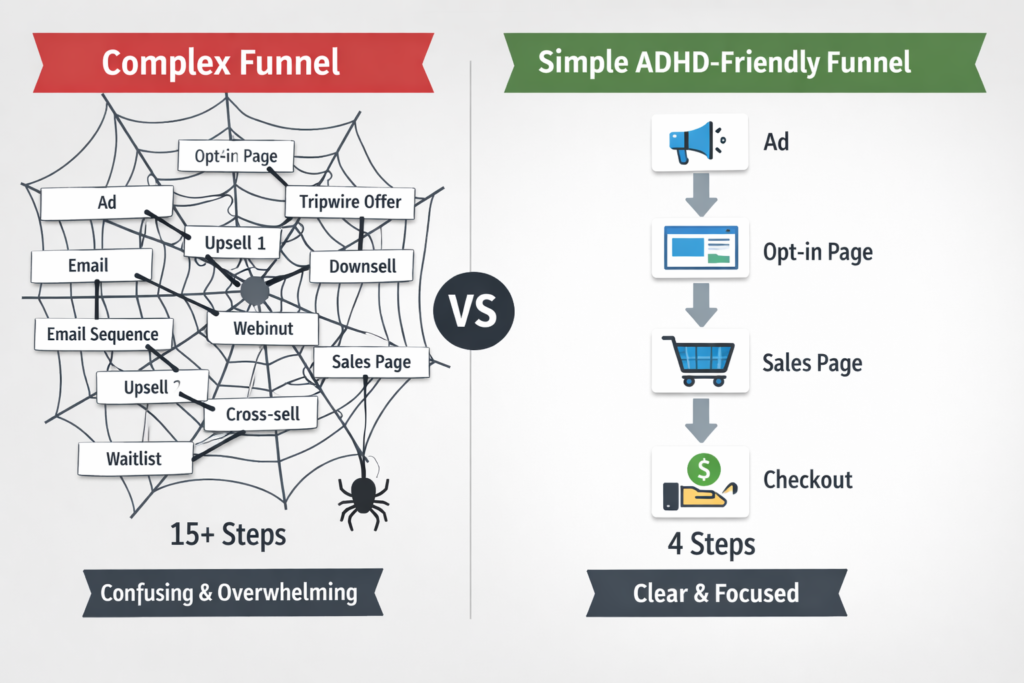
An ADHD-friendly funnel is simple enough to remember without a manual, continues working when you forget about it for a week, and is easy to troubleshoot when something breaks. It has four core pieces: one main offer, one discovery method, one purchase system, and one follow-up process.
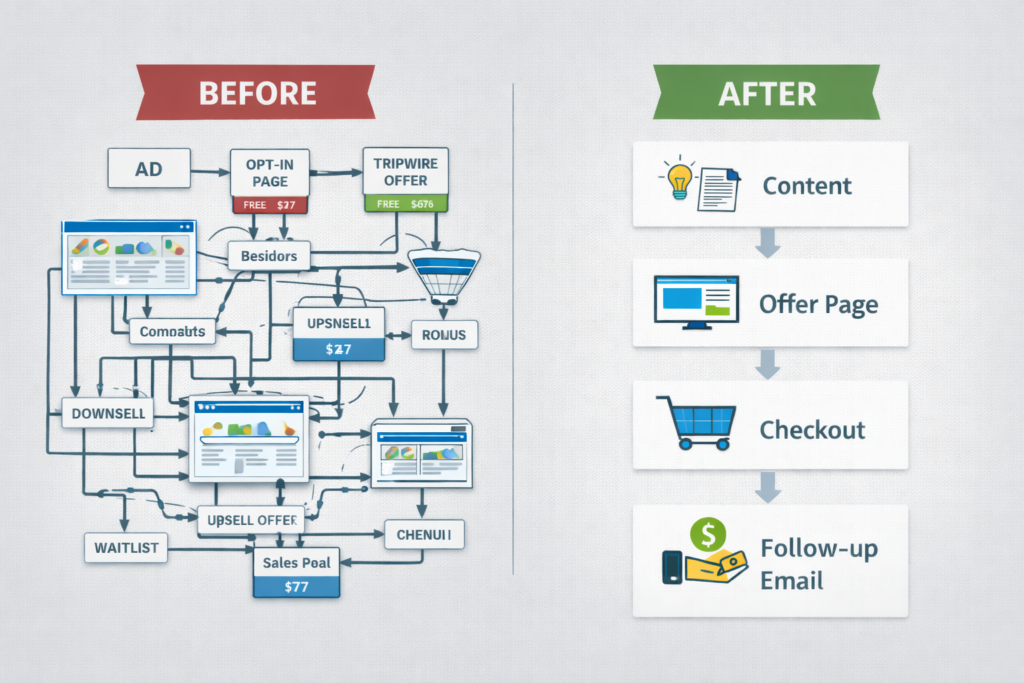
Most funnel training teaches you tripwires, upsells, downsells, webinar sequences, challenge funnels, and segmentation logic that looks like a conspiracy theory diagram. If you have ADHD, your brain loves this at first. Planning feels exciting. Mapping flows feels productive. You get a dopamine hit from sketching out all the possibilities.
Then reality hits. You get stuck in tech hell and never launch. Or you launch but the funnel is so complicated you can’t figure out what’s broken. Or you burn all your energy building and have nothing left to actually drive traffic to your business.
The problem isn’t you. The problem is sales funnels designed for robots, not human beings with real lives and ADHD brains.
Traditional marketing funnels fail ADHD entrepreneurs for specific, predictable reasons.
First, they’re long projects with delayed payoff. ADHD brains need quick wins and immediate feedback. A three-week funnel build with no visible progress is a recipe for procrastination and shame.
Second, they require holding too much information in working memory. If you need a diagram to remember how your funnel works, it’s already too complicated. ADHD entrepreneurs struggle with working memory, so a funnel with ten moving pieces means you’ll never know what to fix when conversions drop.
Third, they assume you’ll remember to follow up, check analytics, and maintain the system. ADHD brains are terrible at “remember to do this thing regularly.” If your sales funnel requires constant attention to function, it will die the second you get distracted by something more interesting.
Here’s what actually works for neurodivergent business owners: a funnel so simple you can explain it in two sentences, that keeps working even when you forget about it, and that’s easy to troubleshoot when something breaks.
Strip all the guru talk away and a funnel is just a way someone finds you, sees what you do, decides if it’s for them, says yes and pays you, and doesn’t fall through the cracks afterward. That’s it.
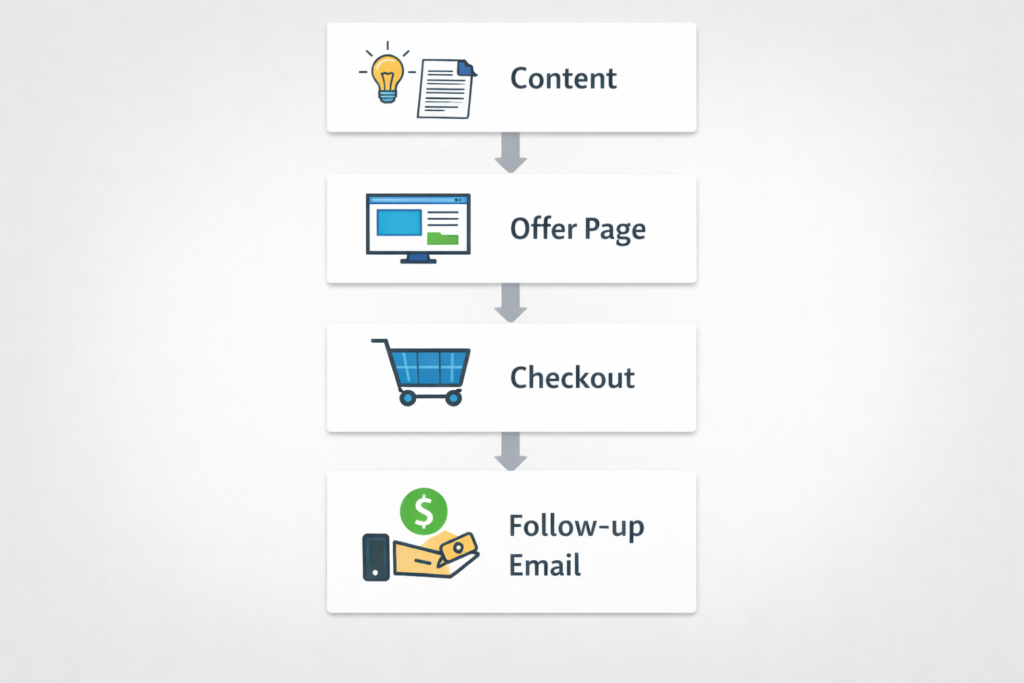
For ADHD entrepreneurs, the minimum viable funnel has exactly four pieces:
If you can’t hold those four pieces in your head without needing a diagram, it’s too complicated.
ADHD loves starting new things. Funnel building loves the idea of “value ladders” and “offer stacks.” Put those together and suddenly you’ve got plans for:
All on paper. None in Stripe.
The simplest way to build an ADHD-friendly sales funnel is to pick one offer that already makes sense. Something you know how to deliver. Something you’ve either sold before or could sell tomorrow. Something that actually moves your people from pain to progress.
If your inner monologue is “Well, it depends…” or “My packages are kind of customizable…” you’re not going to feel confident making offers. So you’ll default back to “helpful content” because that feels certain.
Here’s what to pick: the offer that feels most doable, least exhausting, and most likely to get your people a real result. That’s your anchor offer. Your simple sales funnel is going to orbit around that one thing. Not “someday.” Not “when I have my whole value ladder arranged.” Now.
Another ADHD trap is trying to be everywhere. TikTok, Instagram, Facebook group, podcast, YouTube, LinkedIn, random summit appearances. I’m not saying you can’t show up in multiple places, but when you’re building a simple funnel for ADHD entrepreneurs, you need to pick one main front door—the place where most people first discover you and move deeper.
That might be:
Everything else can be bonus. But when you think “How does someone enter my world?” you want one primary answer. That’s where your ADHD-friendly funnel starts.
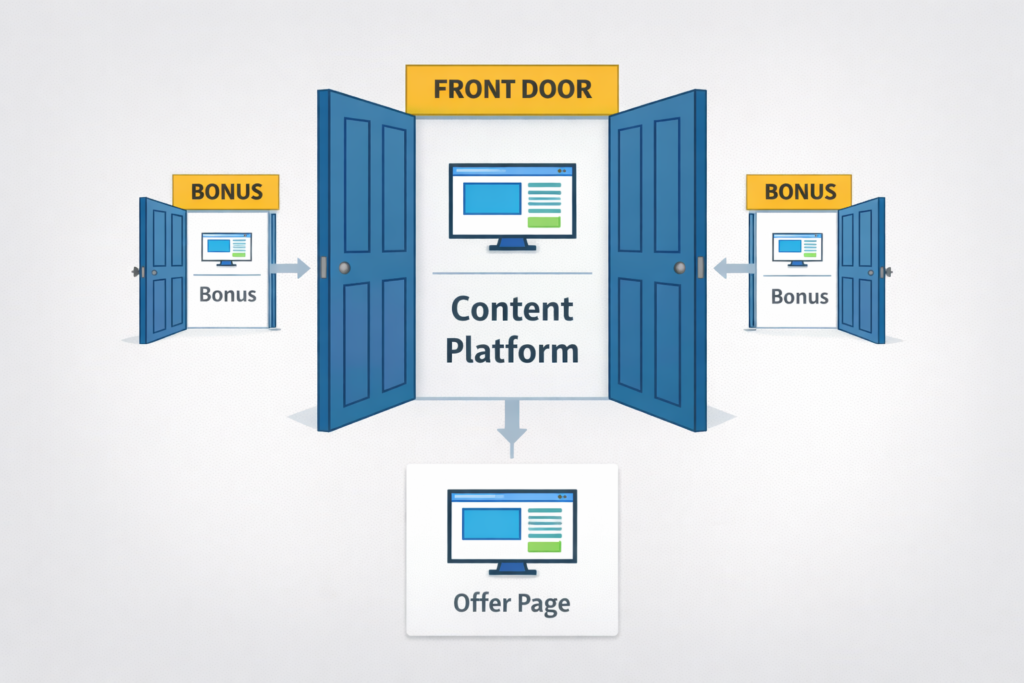
Here’s what a real-life ADHD-friendly sales funnel looks like. Someone sees your content on your primary platform. That content points them to something specific that helps them with the next step. That next step points them to your core offer. If they’re not ready, you stay in touch in a low-energy, sustainable way.
Let’s make this concrete. You share content about broken websites and messy tech. Inside that content, you regularly invite people to:
On the back end, you’ve got a simple landing page or blog post that explains the next step, a checkout or booking page that actually works, and a handful of follow-up emails so the relationship doesn’t die if they don’t buy on the first click.
That’s an ADHD-friendly funnel. It doesn’t sound sexy, but it works—and you can actually finish building it.
If you need help building this exact system, Launch Squad walks you through it step by step with real feedback on your pages and tech support when you get stuck.
A lot of ADHD entrepreneurs design funnels for a version of themselves who has infinite energy, never forgets anything, and loves sitting inside platforms tweaking marketing automation.
You know that person isn’t you.
So instead of asking “What’s the most powerful funnel I could build?” try asking “What’s the simplest path my actual energy can sustain for the next six to twelve months?”
If email marketing is hard for you, don’t design a simple sales funnel that lives or dies on a twenty-email sequence. If live launches drain you, don’t start with a challenge funnel that requires showing up on Zoom five days in a row.
Real-life constraints aren’t failures. They’re guardrails. An ADHD-friendly sales funnel works with your brain, not against it.
At minimum, you need:
That might look like one “Work With Me” page that focuses on your main offer, a single checkout or application plus booking link, and a short email sequence or weekly email where you share what you’re working on and how they can step in.
If you can’t hold those three pieces in your head without needing a diagram, it’s too complicated. Build that before you even think about quizzes, multi-step upsells, or fancy launch events.
One of the reasons sales funnels feel brutal to ADHD business owners is that they’re usually long projects, invisible for most of the build, and tied to a huge emotional payoff at the end. That’s a recipe for procrastination and shame.
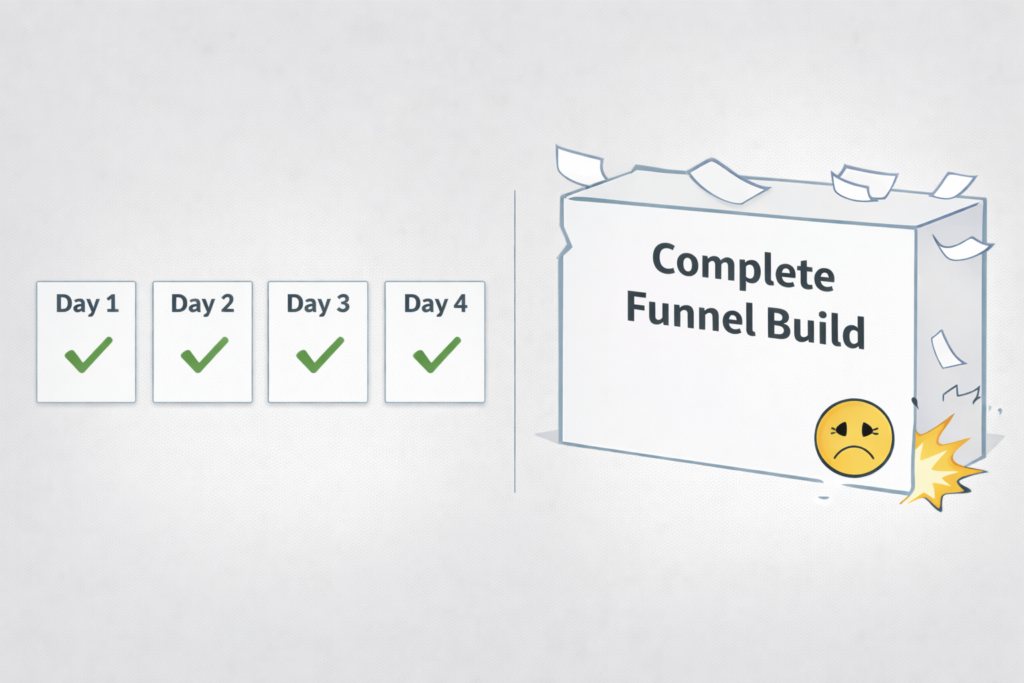
So instead of treating your ADHD-friendly funnel as One Big Project, treat it like a series of small shippable wins:
You don’t need a three-week “funnel sprint.” You need small actions that give you quick feedback and keep you in motion. This is how you build a simple funnel for ADHD entrepreneurs without burning out halfway through.
Here’s a question almost no one asks when building sales funnels: “When this doesn’t work the first time, how easy will it be to see what’s wrong?”
That question will save you. If your ADHD-friendly sales funnel has ten moving pieces, you won’t know what to tweak when you get low conversions. Is it the lead magnet? The opt-in page? The tripwire? The main offer? The email sequence?
If your simple sales funnel has fewer pieces, you have fewer suspects. That’s a gift. You can look at real data, make a small change, and try again. This is especially important for ADHD entrepreneurs because decision fatigue and ambiguity are what shut you down.
A simple funnel for ADHD business owners means you can actually troubleshoot without needing a PhD in marketing analytics or conversion optimization.
Perfectionism and ADHD are best friends. You want the copy just right, the flow impeccable, the tech flawless. That desire for excellence isn’t bad. But if you’re honest, it has probably kept you from shipping things that were totally good enough to test.
Version one of your ADHD-friendly funnel is not a reflection of your worth. It’s just a hypothesis, a first draft, a way to gather honest feedback from the real world.
You will not know what needs improving until actual humans move through it. So let the first round be clunky. You’re allowed to fix typos, tweak copy, and improve visuals as you go. You don’t have to disappear for six months building a masterpiece before you show anyone anything.
Let’s be explicit about this for your nervous system. You do not need:
Will those things matter later? Some of them, maybe. But they are not prerequisites for making money online. For ADHD entrepreneurs trying to get something launched, they’re usually delay tactics dressed up as “strategy.”
If you spend enough time online, you start building sales funnels to impress other marketers. “Look at my segmentation.” “Look at my multi-step logic.” “Look at my conversion event tracking.”
Your actual people—the ones you want to help—do not care about any of that. They care about:
A simple funnel for ADHD business owners does those things without turning you into your own full-time tech support department.
If this whole time you’ve been quietly thinking “Maybe I’m just not cut out for this,” I’m going to push back on that. You doing everything manually, from scratch, with no clean path for people to follow? That would burn out anyone, ADHD or not.
You don’t need a more complicated strategy. You need an ADHD-friendly sales funnel that matches your brain, your capacity, and your actual people. Once that’s in place, everything else starts to feel less heavy.
People with actual problems are out there right now. They’re bleeding time on broken funnels, losing leads on confusing websites, stuck in analysis paralysis because they don’t know who to trust. They’re scrolling past a thousand pieces of content a day. They don’t need more vague inspiration. They need clear paths to real help.
If what you offer is genuinely helpful, then making offers isn’t selfish. It’s responsible.
This is exactly what we work on inside Launch Squad. It’s for solo service providers who are overwhelmed by tech and conflicting advice, tired of half-built funnels and stalled launches, and ready to build something simple that actually works when people click.
Inside, we keep it practical:
If you want a place where “done is better than perfect” isn’t just a quote, it’s how we operate, join Launch Squad.
Your brain is not the problem. The overcomplicated funnels are. Let’s build one that fits you.